
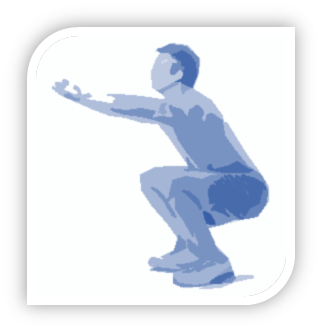
 Many years ago when I was learning about muscle actions for the first time, an area of confusion arose that lasted for some time.
I could not fully comprehend antagonistic muscle action during the squat. Specifically, how concurrent co-activation of antagonists involved in the movement (the rectus femoris of the quadriceps and the hamstrings) did not cancel each other out and neutralise any movement.
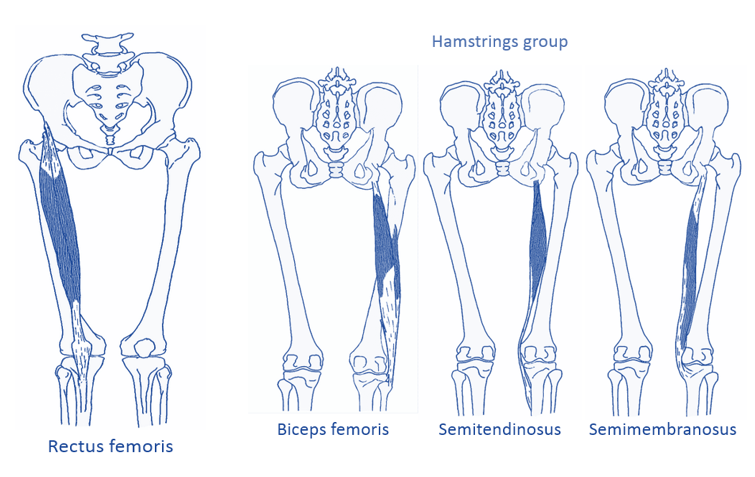
During the concentric phase of the squat (i.e. when standing up), the quadriceps (including the rectus femoris) contract to extend (straighten) the knee. The rectus femoris is a bi-articular muscle in that it crosses two joints, the knee and hip. As muscles cannot develop different levels of force in their different parts, when the rectus femoris contracts to extend the knee, it also flexes the hip joint.
Likewise, the gluteus maximus and hamstrings contract to extend the hip. The hamstrings are also bi-articular muscles (crossing both the hip and knee), so when they contract to extend the hip they also flex (bend) the knee.
My problem is thus; during the concentric phase of the squat (standing up), the rectus femoris extends the knee whilst the hamstrings flex it, and the hamstrings extend the hip whilst the rectus femoris flexes it – so why do they not simply cancel each other out? With all these opposing joint actions, how does knee and hip extension actually result?
 Click to enlarge
Until recently, I had not been able to find an acceptable answer to this. Then I came across Lombard’s paradox, the name given to the phenomena described above, after its namesake Warren Lombard wrote an article on it in 1903. This introduced me to the discipline of biomechanics, and brought some much-welcomed clarity to this problem. The typical explanation of how this works is given below.
At the hip, the rectus femoris attaches close to the hip joint, whereas the hamstrings attach further away on the ischial tuberosity. The hamstrings thus have a greater moment arm than the rectus femoris (although this advantage lessens as the thigh extends).
At the knee, the axis of rotation lies towards the back of the femoral condyles. The hamstrings attach close to the back of the knee, whereas the patella holds the rectus femoris muscle away from the knee’s axis. This gives the rectus femoris a greater moment arm than the hamstrings and this advantage increases as the knee extends.

So, what does this mean? Let’s use an analogy to try and visualise this. Think about a door with the hinge acting as the axis of rotation. It is easier to open or close the door when you push on the side farthest from the hinge than it is to push the door close to the hinge.
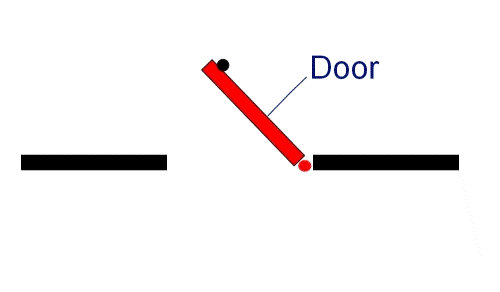 Likewise, the hamstrings act on the hip but attach farther away from its axis of rotation than the rectus femoris; they therefore generate more force than the rectus femoris allowing hip extension to take place. At the knee, the rectus femoris (and other quadriceps muscles) attach farther from the axis of rotation in the knee than the hamstrings, thereby generating more force and allowing knee extension to take place.
I have no doubt over-simplified this phenomena, but in so doing it is hopefully more accessible.